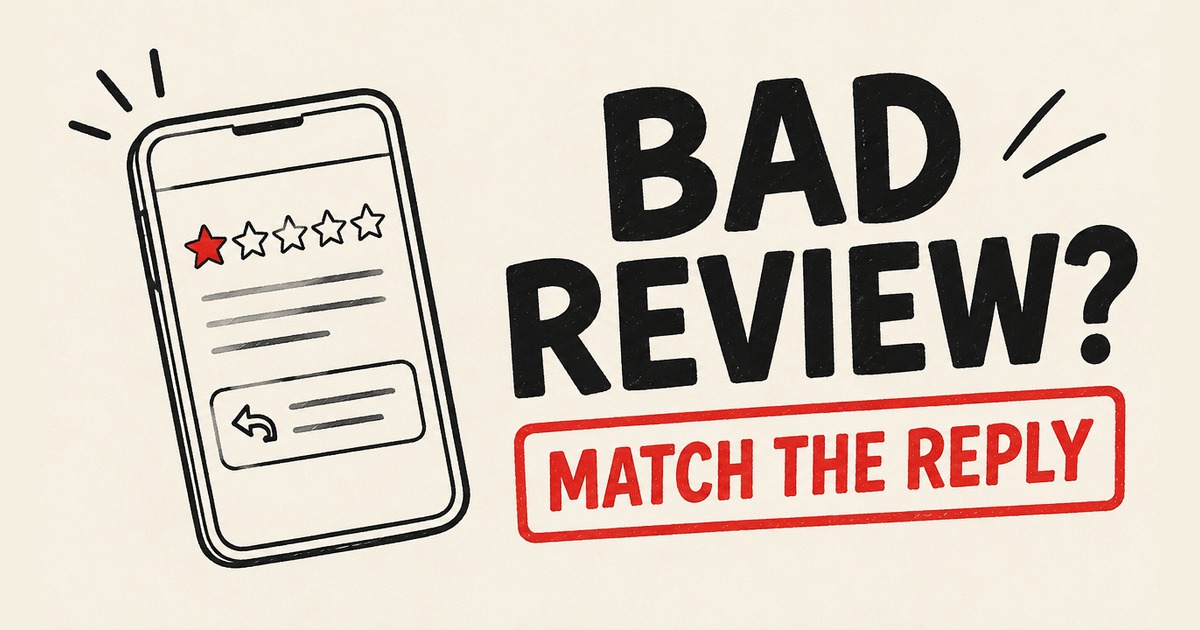
How to respond to negative reviews (with examples): match the reply to the fault
To respond to negative reviews well, reply within a day, keep it short and calm, and match the reply to the fault. If you got it wrong, say so and fix it. If you didn't, explain once, without arguing. If the review is fake or breaks Google's rules, flag it and post a brief, neutral reply.
Prefer to watch? We turned this guide into a 2-minute explainer: How to Respond to Negative Reviews: Match the Reply to the Fault.
Picture a Tuesday at 9:40 at night. You're closing up when your phone buzzes. A new one-star review says you overcharged a customer and nobody called them back. Your face gets hot, and you want to type something right now.
Don't. Not yet. In our last post, we asked whether there's really such a thing as bad publicity. We looked at Nvidia, Bud Light and American Eagle, and one lesson kept coming back: a response only helps when it fits the fault. A Google review is the same problem on a smaller stage. This guide turns that lesson into four example replies you can copy, then shows why steady reputation management, not a one-off reply, is what protects your name.
Why does your reply matter more than the review?
The reviewer isn't your only reader. Future customers read your reply to see how you treat people when something goes wrong. Your reviews also affect whether those customers find you at all, and research on hotels shows that replying changes what the next reviewers write. One calm answer works for months.
Start with being found. Google says reviews are part of a business's "prominence," and that "more reviews and positive ratings can help your business's local ranking." Then there's money. A Harvard Business School study found that a one-star increase on Yelp led to a 5% to 9% increase in revenue for independent restaurants, with no such effect for chains (Luca, 2011). The less known you are, the more each review counts.
Replies change the reviews that come next. When hotels started answering their TripAdvisor reviews, they got 12% more reviews and their ratings rose 0.12 stars on average (Proserpio and Zervas, Marketing Science, 2017). The researchers found unhappy guests became less likely to post short, unfair complaints once they knew someone was reading.
It isn't instant, though. A 2024 study tracked more than 804,000 hotel reviews and 393,000 replies. Answering negative reviews brought a short dip in ratings and revenue, then gains over time (Wu, Ye and Chu, Journal of the Academy of Marketing Science). The replies helped most with people who hadn't been customers yet, which is exactly who you're trying to win. So replying has to be steady, month after month, not a one-time fix. That steady work is what reputation management is.
What should you check before you reply?
Ask one question before you type: whose fault was this? Your answer puts the review in one of four cases. Each case gets a different reply, because an apology that fits the facts helps, and one that doesn't can make things worse. This check takes about 30 seconds and saves you from the most common mistake.
That rule comes from research on companies in real trouble. A study of 223 corporate crises found that apologizing limited the damage when the company was at fault. When it wasn't at fault, apologizing made things worse, and staying away from an apology protected it (Racine, Wilson and Wynes, Journal of Business Ethics, 2018). The authors' advice was to match the apology to your real share of the blame.
A bad review is a tiny crisis, so the same rule applies. Here are the four cases:
What happened | What your reply does |
|---|---|
We got it wrong | Apologize, say what you fixed, and offer to make it right |
Partly our fault | Own your part, explain the rest in one sentence, invite them back |
Not our fault | Thank them, state the facts once, offer to talk |
Fake or breaks Google's rules | Flag it, then post one short, neutral line |
If you can't tell which case you're in yet, wait until you can. Ask the person who did the job, check the invoice or the booking, and then reply. A few hours of checking beats a fast reply you have to walk back.
How do you respond to a negative Google review? Four example replies
Use the customer's name, name the exact problem, say what happens next, and sign with a real person's name and role. Keep it under about 80 words. Move details like refunds, account numbers and phone calls offline. Here's one sample reply for each of the four cases, written for a home services business.
1. We got it wrong.
Hi Dana, you're right, and I'm sorry. We quoted $180 and charged $240, and nobody called you back. That's on us. I refunded the $60 difference to your card today. If you're willing, call me at the shop so I can make sure the rest of the job was done right.
Mike, owner
2. Partly our fault.
Thanks for telling us, Sam. We were two hours late on Saturday, and that part is on us. We were a person short, and we should have called you. The price was the one we quoted in writing, though. We've added a second technician on weekends, and we'd like the chance to do better next time.
Rosa, office manager
3. Not our fault.
Thanks for the review, Jordan. We checked your file: the warranty covers parts for 12 months, and this repair came up in month 14. We know that's frustrating to hear. We'd still like to walk you through your options, so please call the shop and ask for the service manager.
Mike, owner
4. Fake, or breaks Google's rules.
We take every review seriously, but we can't find any visit or job under this name or around this date. If we've missed something, please call the shop so we can look into it.
The team at [your business name]
How do you report a fake review to Google?
After you reply, report it. Google lets you flag a review from your Business Profile, but only reviews that break its policies can be removed. Disagreeing with a review isn't enough, and Google says it doesn't take sides in disputes between a business and a customer. The check typically takes several days, and you get one appeal if you think Google got it wrong.
Two details help with timing. Google checks replies before they show, which usually takes up to 10 minutes but can take up to 30 days. And the customer gets a notice when you reply and can still edit their review afterward. A fair reply gives them a reason to.
How fast should you reply, and what should you never write?
Aim to reply within one business day, after you've done the 30-second check. A fast reply shows you're paying attention, but a fast wrong reply is worse than a slow right one. Then avoid four things: arguing, sharing private details, offering something for a better review, and pasting the same reply everywhere.
Don't argue. Calling a reviewer a liar, or listing everything they did wrong, turns one bad review into a public fight. State your facts once and stop.
Don't share private details. This matters most in health care. In 2023, a New Jersey psychiatric practice paid $30,000 to settle with federal regulators after it disclosed patients' diagnosis and treatment details while replying to their Google reviews. "Simply put, this is not allowed," said Melanie Fontes Rainer, then director of the HHS Office for Civil Rights. If you're a health care practice, don't even confirm that the reviewer is a patient.
Don't trade anything for a better review. A 2024 Federal Trade Commission rule bans incentives tied to a review saying something positive or negative. It also bans legal threats, intimidation and false accusations used to get a negative review taken down. Fix the problem because it's the right thing to do, then let the customer decide what to write.
Don't paste the same reply everywhere. In the 2024 hotel study, the businesses whose replies all sounded alike got less benefit from replying. People can tell a form letter from an answer.
Why do reputation management tools and services matter?
Replying well once is easy. Doing it for every review, on every site, within a day, for years, is the hard part. Reputation management tools and services do that steady work: they catch each new review, help you answer it the right way, and keep new reviews coming in within the rules.
Reviews are the last step of the path every customer takes: they hear about you, choose you, hire you, and then talk about you. That last step feeds the next customer's first.
What does a reputation management service handle?
Here's what a good setup covers for a small or medium sized business:
Every review, in one place. Google, Facebook, Yelp and industry sites all collect reviews. Alerts bring each new one to you the same day.
Replies matched to the fault. Each reply is written for that review and its case. You approve replies to negative reviews before they post, and thank-yous to happy customers are handled for you. No form letters.
Fake reviews flagged and followed up. Reports go in, the status gets checked, and the one appeal is used when it's worth it.
More reviews, asked for the right way. Every customer gets a request after the job, not only the happy ones. Google bans businesses from selectively asking for positive reviews or discouraging negative ones.
Patterns, not just reviews. If three reviews mention late callbacks, the fix is a callback rule, not a better reply.
What does it cost to leave reviews unanswered?
Each week a negative review sits without a reply, it's the newest thing a stranger reads about you, and silence reads as your answer. Catching every review, writing a fitting reply within a day and turning complaints into fixes takes real time every week. That steady reputation management is a big part of what a digital marketing partner does for small and medium sized businesses. It's also part of how search visibility works: getting found matters, and so does what people find.
A negative review isn't the end of the story. It's a test you get to pass in public, and the people still deciding whether to call you are watching how you answer.
Artenon is a New York based digital marketing agency for small and medium sized businesses. Reputation care is part of that work, alongside search, social, ads and your website: we help more of your customers talk about you, and help you answer when they do. If you want to see how people find, see and talk about your business, start with a free Custom Digital Presence Review, built around your business. It includes a look at your reviews today: your rating, how recent they are and how many have a reply. Schedule your free review.


