
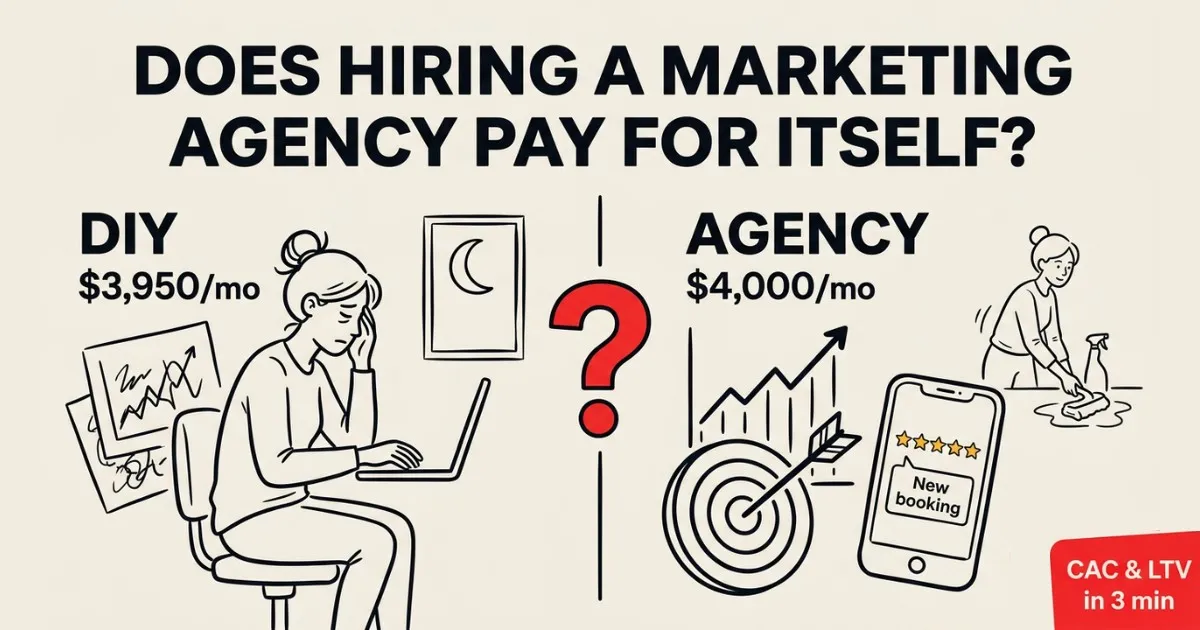
Does Hiring a Marketing Agency Pay for Itself? CAC and LTV Explained
Hiring a marketing agency makes financial sense when it lowers what you pay to win each customer, or raises how much each customer is worth, by more than it costs. Two numbers tell you which side of that line you're on: CAC and LTV.
Most small business owners decide whether to hire a marketing agency on gut feel. The agency fee looks big, so they keep doing it themselves at night. Or a competitor seems to be everywhere online, so they sign up with the first agency that calls. Both are guesses.
This guide explains CAC and LTV in plain English, walks through one business's numbers start to finish, and shows you how to run your own in about 15 minutes.
Watch: CAC & LTV explained in 3 minutes
CAC: what it costs you to win one customer
Customer Acquisition Cost (CAC) is everything you spend on marketing in a period, divided by the new customers you got in that period.
CAC = Total marketing cost ÷ New customers won
The word that trips people up is "total." Ad spend is only part of it. A true CAC includes:
Ad spend on Google, Meta, local directories and so on
Tools and software such as your website builder, email platform, scheduling and design apps
People — salaries, freelancers, agency fees
Your own time, valued at what an hour of your time is worth to the business
Example. Maria runs a home cleaning company. Last month she spent $1,500 on ads and $150 on tools. She also spent 25 hours writing posts, tweaking ads and fixing her website. Her time is worth about $75 an hour, so that's $1,875 more. Marketing also keeps changing, with new apps, new ad rules and new places people spend their time, so keeping up takes her about 5 more hours ($375) plus $50 in courses and subscriptions. Total: $3,950. Even with all that effort, her results don't match what a pro gets, and no one would expect them to: marketing isn't her area of expertise, cleaning is. She won 6 new customers.
Her CAC is $3,950 ÷ 6 = about $660 per customer. If she had counted only ad spend, she'd think it was $250 — and she'd make the wrong decision.
LTV: what one customer is worth to you
Customer Lifetime Value (LTV) is the profit a typical customer brings you over the whole time they stay with you. Use profit, not revenue: a $200 job that costs you $100 to deliver is worth $100 to you.
LTV = Average sale × Purchases per year × Years as a customer × Profit margin
Example. Maria's average cleaning is $150. A typical customer books 8 times a year and stays 2 years. Her profit margin after labor and supplies is 50%.
Her LTV is $150 × 8 × 2 × 0.50 = $1,200 per customer.
If you don't know how long customers stay, look at your past customers from two or three years ago and count how many still book. A rough, honest guess beats no number.
Putting them together: the LTV:CAC ratio and payback
Divide LTV by CAC and you get the single most useful number in marketing: how many dollars of profit each marketing dollar brings back.
LTV:CAC = LTV ÷ CAC
A widely used benchmark comes from venture investor David Skok, who notes the best subscription businesses run an LTV:CAC "higher than 3" (source). The same logic applies to any business that wins repeat customers:
LTV:CAC | What it means |
|---|---|
Below 1:1 | You lose money on every new customer |
1:1 to 3:1 | You're growing, but thin margins leave little room for error |
About 3:1 | Healthy — the usual target |
5:1 or higher | Strong; you may be underspending and leaving growth on the table |
Maria's ratio is $1,200 ÷ $660 = under 2:1. She's making money, but not much, and most of her "cost" is her own evenings.
The second number is payback period: how many months until a new customer has paid back what it cost to win them. Cash-tight businesses feel this one most.
Payback (months) = CAC ÷ Monthly profit per customer
Maria earns about $50 a month in profit per customer ($150 × 8 × 50% ÷ 12). Her payback is $660 ÷ $50 = about 13 months. Skok observes that strong businesses recover CAC in 5 to 7 months, and that profitability turns "anemic" past 12 months. Maria is past that line.
The hidden costs of doing it yourself (or hiring in-house)
DIY marketing looks free because no invoice arrives. It isn't. Every hour you spend on ads is an hour you're not selling, serving customers or running the business.
The costs that rarely make it into the math:
Your time. If you could bill or sell $75 or more an hour, ten hours a week on marketing costs over $3,000 a month.
Wasted ad spend. Broad targeting, missing conversion tracking and ads pointed at a homepage instead of a landing page quietly burn budget.
Keeping up. Marketing keeps changing: new apps, new ad rules, new places people spend their time. Staying current costs hours and money every month, and it never ends.
Hiring in-house has its own math. The median marketing specialist earns $78,760 a year (BLS, May 2025). Wages are only 70% of what private employers pay per employee; benefits make up the other 30% (BLS, June 2026). That puts one marketer at roughly $112,500 a year, or about $9,400 a month, before tools or ad spend.
Side by side: DIY vs. in-house vs. agency
Let's be conservative. Say a pro, in-house or agency, brings in only two more customers a month than Maria does on her own. And say Maria puts the energy she was spending on marketing into her customers instead, so they stay three years instead of two and each one is worth $1,800 instead of $1,200. Salary and benefits use the BLS figures above; everything else is an example, so plug in your own:
DIY | In-house hire | Agency | |
|---|---|---|---|
Ad spend | $1,500 | $2,000 | $2,000 |
Tools | $150 | $400 | Included |
Keeping up (5 hrs + courses) | $425 | Part of the job | Included |
Marketing labor | — | $9,400 (salary + benefits) | $2,000 (flat fee) |
Owner's marketing time | 25 hrs = $1,875 | 5 hrs = $375 | — |
Total monthly cost | $3,950 | $12,175 | $4,000 |
New customers | 6 | 8 | 8 |
CAC | $658 | $1,522 | $500 |
LTV | $1,200 | $1,800 | $1,800 |
LTV:CAC | 1.8:1 | 1.2:1 | 3.6:1 |
Why the agency comes out ahead, even in the conservative case:
Dedicated expertise. Marketing is the agency's whole job, so it doesn't pay to learn on your budget.
Focus. Your marketing gets consistent attention instead of whatever is left at the end of a long day.
Economies of scale. Tools, systems and know-how are shared across many clients, so a flat fee costs far less than one in-house salary.
Each side does what it does best. Specialists run the marketing; the owner puts her energy into the service and the customers, where no one can replace her.
Here's how Maria's extra profit builds, month by month, against the agency's extra cash cost of $2,350 a month ($4,000 vs. her $1,650 in ads and tools):
Month | From 2 more customers a month | From customers staying longer | Total extra profit |
|---|---|---|---|
3 | $600 | $900 | $1,500 |
6 | $1,200 | $1,800 | $2,400 (covers the extra cost) |
12 | $2,400 | $3,600 | $4,800 (about $2,450 a month ahead) |
It's an investment that pays back over months, not on day one. By about month six it has paid for itself, and it keeps climbing from there.
At Maria's size, an in-house salary swallows the gain. Hiring tends to make sense later, once marketing spend is large enough to keep a specialist fully busy.
This won't be true for every business. The point is to run your own numbers, not to trust ours.
When hiring a marketing agency makes sense (and when it doesn't)
Hire an agency when it can realistically push your LTV:CAC toward 3:1 or better and its fee is less than what you'd save plus earn. The signs:
Your LTV:CAC is below 3:1, or you've never calculated it
You spend more than 5–10 hours a week on marketing
Your payback period is longer than 6 months
Ad spend is going up but new customers aren't
You can't say which channel brings your best customers
You want to grow faster than your own evenings allow
Hold off when:
Your LTV is very low and can't support any fee yet — fix pricing or repeat business first
You have more work than you can deliver — more leads would hurt, not help
Your ratio is already 3:1 or better and you enjoy the work
You can't commit at least 3–6 months; results need time to compound
The test is simple: hire an agency for what it does better or cheaper than you can, such as expertise, focus and scale. Don't hire one for something you could fix yourself with a free afternoon.
The part of your reputation no one can do for you: delivering well
The strongest brand-builder you have is doing the job you were paid to do, and doing it well. Marketing can fill the door, but it can't make customers want to come back. If they line up once and never return, your LTV collapses and every new customer costs full price to replace.
Keeping customers is where the money is. Research by Frederick Reichheld of Bain & Company found that raising customer retention by 5% increases profits by 25% to 95% (HBR). Most of what drives retention happens inside the business: quality, reliability, how easy you are to work with, and how customers feel when the job is done.
That's often overlooked, and it's where an owner's time pays back most. Most businesses have plenty of room to improve the customer experience and run more efficiently. Every hour spent there raises LTV and margins. Measured against that, an evening spent tweaking ads is rarely the best and highest use of an owner's time. That's what makes handing marketing to specialists an easy call.
That's the real case for delegating. When specialists run the marketing, Maria can put her energy into faster follow-ups, check-ins and a little extra care. In the example above, that's what turns a modest marketing gain into a clear win: customers who stay a year longer are worth 50% more. These are example numbers, not a promise, but the direction holds. Good marketing from people who do it every day, plus better service from the person who knows the business best, is the best of both.
Run your own numbers in 15 minutes
Grab last quarter's numbers and a calculator.
Add up total marketing cost for the quarter: ads, tools, freelancers and your own hours times your hourly value.
Count new customers from the same quarter.
Divide cost by customers. That's your CAC.
Work out LTV: average sale × purchases per year × years they stay × profit margin.
Divide LTV by CAC. Below 3:1 means there's room to improve.
Find payback: CAC ÷ monthly profit per customer.
Get a quote and rerun the math with the agency's fee plus your ad spend. Be conservative about how many more customers you'll win.
If the agency scenario still comes out ahead with cautious numbers, hiring the agency isn't an expense. It's a better return on money you're already spending.
Want to see where you stand first? Artenon's free Custom Digital Presence Review looks at how your business shows up online today, and how it could. It's a good starting point before you decide who should run your marketing. Schedule your free review.
Sources
Market Research Analysts and Marketing Specialists: Pay — U.S. Bureau of Labor Statistics, Occupational Outlook Handbook (May 2025 data)
Employer Costs for Employee Compensation, June 2026 — U.S. Bureau of Labor Statistics
SaaS Metrics 2.0: A Guide to Measuring and Improving What Matters — David Skok, For Entrepreneurs
The Value of Keeping the Right Customers — Amy Gallo, Harvard Business Review (Oct 29, 2014)


